
If you’ve ever stood in front of a concrete wall wondering which anchor system to use, you’re not alone. The chemical versus mechanical anchor debate has been going on for years, and honestly, both sides have valid points.
I’ve seen plenty of jobs where the wrong anchor choice led to callbacks, failed inspections, or worse—safety issues. So let’s cut through the marketing fluff and talk about what actually matters on site.
What’s the Real Difference?
Here’s the thing most people get wrong: it’s not about which one is “better.” It’s about matching the anchor to your specific application.
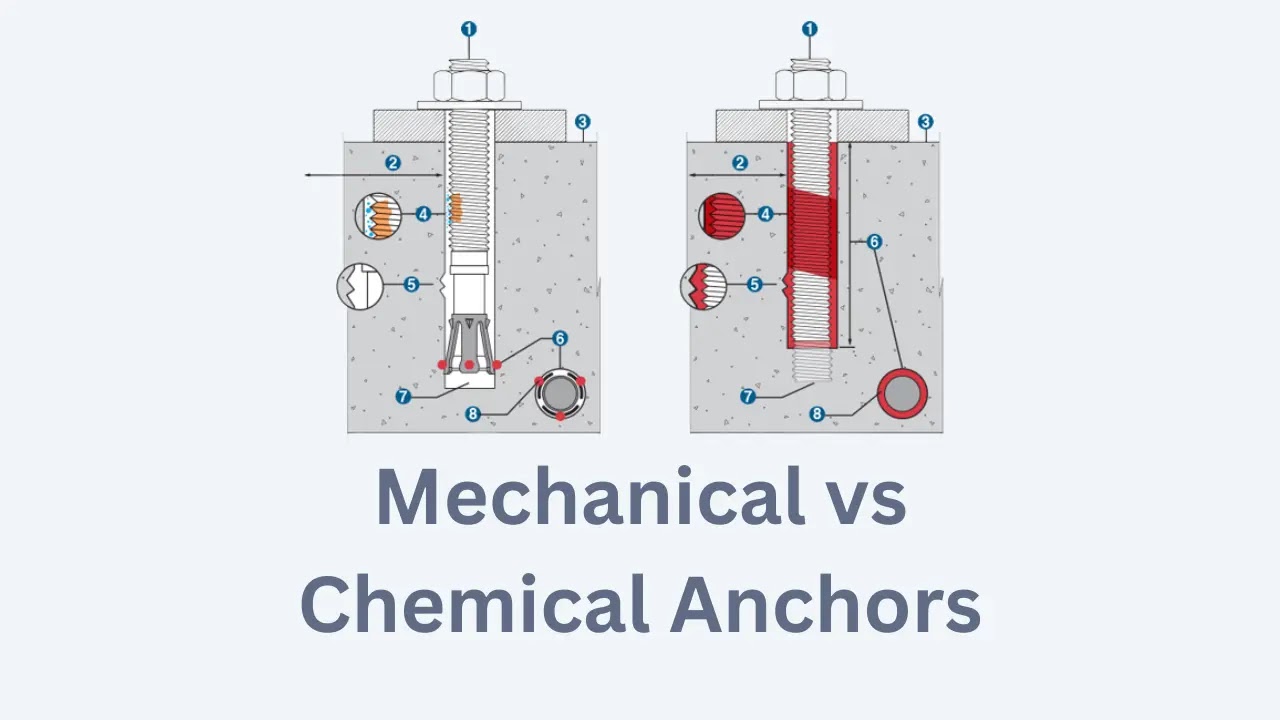
Mechanical anchors work by expansion or undercut mechanisms. Think wedge anchors, sleeve anchors, or drop-in anchors. You drill a hole, insert the anchor, and tighten it up. The anchor grips the concrete mechanically.
Chemical anchors use a two-part resin that bonds the threaded rod or rebar directly to the concrete. You’re essentially gluing steel into stone with an incredibly strong adhesive system.
When Mechanical Anchors Make Sense
Let’s be practical here. If I’m hanging HVAC brackets, electrical conduit, or light-duty fixtures, I’m reaching for mechanical anchors every time.
The Advantages Nobody Talks About
Speed matters on site. A sleeve anchor takes maybe two minutes to install. No mixing, no waiting, no mess. When you’ve got 50 brackets to install before lunch, that efficiency adds up.
You can adjust them. Made a mistake? Most mechanical anchors can be removed and repositioned. Try doing that with a chemical anchor that’s already cured.
They’re idiot-proof. I say this with love, but you can hand a tradesman a box of wedge anchors and they’ll figure it out. There’s less room for installation error.
Where They Fall Short
The problem with mechanical anchors is they rely on the concrete being in good condition. Cracked substrate? Edge distances too close? Older concrete that’s a bit crumbly? Your holding power drops dramatically.
I’ve seen mechanical anchors pull out of 30-year-old concrete that looked fine but just didn’t have the compression strength anymore. Not a fun conversation with the engineer.
Why Chemical Anchors Are Worth the Extra Effort
Here’s where chemical anchors earn their keep: high-load applications where failure isn’t an option.
The Performance Difference is Real
Chemical anchors typically achieve 30-50% higher load capacity than equivalent mechanical anchors. That’s not marketing—that’s what the test data shows.
For structural applications like steel-to-concrete connections, heavy machinery mounts, or seismic retrofitting, chemical anchors are often the only code-compliant option.
They Handle Problem Situations
Got cracked concrete? Chemical resin fills those cracks. Working close to an edge? Chemical anchors maintain their capacity where mechanical would fail. Installing in hollow core or lightweight concrete? Chemical is your only real option.
I’ve used chemical anchors to retrofit earthquake bracing in buildings where mechanical anchors simply couldn’t meet the load requirements.
The Learning Curve is Real Though
Chemical anchors require proper technique. The hole needs to be clean—and I mean actually clean, not “looks clean enough.” Temperature matters. Cure time matters. Mix the resin wrong and you’ve got an expensive paperweight.
Breaking Down the Cost Equation
Yes, chemical anchors cost more upfront. A single chemical anchor installation might run you $15-30 depending on size, versus $3-8 for a mechanical anchor.
But here’s the math that matters: what’s the cost of a callback? What’s the cost of over-engineering because your anchors can’t hit the required loads?
On a recent commercial job, we spec’d chemical anchors for the structural steel connections. The material cost was about $3,000 more than mechanical would have been. But we reduced the number of anchor points by 40% because of the higher capacities. Plus, no callbacks.
Application Guide: What I Actually Use
Light-duty (under 5kN): Mechanical anchors all day. Sleeve anchors or wedge anchors for most applications.
Medium-duty (5-15kN) in good concrete: Either works. I’ll usually go mechanical for speed unless edge distances are tight.
Medium-duty in questionable concrete: Chemical anchors. Not worth the risk.
High-load structural (over 15kN): Chemical anchors, almost always. Sometimes there’s no choice—the engineer specs it and that’s that.
Cracked concrete, edge applications, or seismic zones: Chemical anchors only. Mechanical anchors lose too much capacity in these conditions.
What the Australian Standards Say
AS 5216 is your friend here. It covers the design and installation of both systems, and it’s worth actually reading if you’re doing structural work.
The key takeaway: both systems can be code-compliant, but the design assumptions are different. Chemical anchors generally allow you to work closer to edges and handle cracked concrete better.
For seismic design categories, you’ll often find chemical anchors are the only pre-qualified option. The building certifier will thank you for doing your homework.
Installation Tips That Actually Matter
For Mechanical Anchors:
- Drill holes to the exact depth specified. Too shallow and you won’t get full engagement. Too deep and you’re just making extra work.
- Clean the hole. I know, I know, everyone says this. But concrete dust reduces holding capacity by up to 25%.
- Check your torque. Over-tightening damages the anchor. Under-tightening and it won’t develop full capacity.
For Chemical Anchors:
- Hole cleanliness is critical. Brush, blow, brush again. Then blow again. I’m not kidding.
- Check your resin temperature. Too cold and it won’t cure properly. Too hot and you’ve got about 30 seconds of working time.
- Don’t skip the cure time. I know you want to load it up, but give it the full cure time listed on the technical data sheet.
The Hybrid Approach
Here’s something worth considering: you don’t have to pick one system for the whole job.
On a recent multi-story fit-out, we used mechanical anchors for all the services brackets and light fixtures. But for the structural steel connections and the emergency stair attachments? Chemical all the way.
This gave us the speed and cost savings where it made sense, and the performance where we needed it.
When to Call in the Experts
If you’re working on:
- Structural connections that’ll be engineered and certified
- Seismic retrofit work
- Anything going into cracked or deteriorated concrete
- High-consequence applications (think overhead loads, public safety)
Then get an engineer involved. The $2,000 you spend on proper design could save you from a $200,000 problem later.
Product Recommendations We Actually Use
For mechanical anchors, we stock Dynabolt, Ramset, and Hilti options. They all work well when installed correctly.
For chemical anchors, we typically specify Hilti HIT-RE 500 V3 or Rawlplug R-KEM II for most applications. For structural work, Fosroc Lokfix is excellent.
The honest truth? Most quality brands perform similarly if you follow the installation guidelines. The bigger variable is usually the person holding the drill.
The Bottom Line
Stop thinking about chemical versus mechanical as a competition. Think about it as different tools for different jobs.
Use mechanical anchors when you need speed, adjustability, and you’re working in good quality concrete with moderate loads.
Use chemical anchors when you need maximum performance, you’re working in problem substrates, or the engineer says you have to (which happens more than you’d think).
And if you’re genuinely not sure? Call our technical team. We’d rather spend 10 minutes on the phone helping you choose the right anchor than deal with a problem down the track.
Need help selecting the right anchor system for your project? Contact TOPFIX at 1300 867 349 or visit our Moorebank showroom. Our technical team can review your specifications and recommend the best solution.