
Anchoring in Cracked Concrete: The Engineering Challenge
Installing anchors in cracked concrete presents one of the most challenging scenarios in structural fastening. While anchors in sound, uncracked concrete behave predictably per design calculations, cracks introduce dynamic movement, reduced bond areas, and potential for progressive failure that standard anchoring methods cannot accommodate.
Understanding the fundamental differences between mechanical and chemical anchors in cracked concrete applications—and compliance with AS 5216:2021—is critical for structural engineers, builders, and contractors working on renovation, seismic retrofitting, or repair projects across Sydney.
At Topfix, we supply both mechanical and chemical anchor systems and provide technical support for AS 5216 compliant installations in cracked concrete. This comprehensive comparison draws on Australian Standards, laboratory testing, and real-world performance data.
Understanding Cracked Concrete Per AS 5216
What Qualifies as “Cracked Concrete”?
AS 5216:2021 Definition: Concrete is considered cracked when crack widths exceed 0.3mm, or when the structure is subject to loading conditions that could induce cracks during the anchor’s service life.
Types of Cracks:
- Static cracks: Stable, non-progressive (settlement, shrinkage)
- Dynamic cracks: Opening and closing under load (seismic, vibration)
- Progressive cracks: Widening over time (ongoing structural movement)
Critical Consideration: Even hairline cracks can widen under seismic or dynamic loading. AS 5216 requires conservative approach when cracks are present or anticipated.
Why Cracked Concrete Matters for Anchors
Performance Impacts:
- Reduced bond area: Cracks eliminate contact between anchor and concrete
- Load path disruption: Forces must transfer around crack
- Movement accommodation: Anchors must handle crack opening/closing
- Progressive failure risk: Crack growth can reduce anchor capacity over time
Load Reduction Factors: Standard anchors in cracked concrete can experience 30-70% reduction in capacity compared to sound concrete, depending on anchor type and crack characteristics.
Mechanical Anchors: Principles and Performance
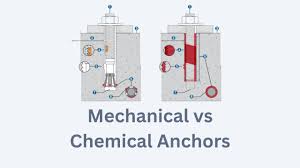
How Mechanical Anchors Work
Basic Principle: Mechanical anchors develop holding capacity through friction, expansion, or mechanical interlock between the anchor and surrounding concrete.
Common Types:
1. Expansion Anchors:
- Wedge anchors: Expanding clip/cone against concrete
- Sleeve anchors: Expanding sleeve around bolt
- Drop-in anchors: Expanding insert in hole
- Mechanism: Radial force creates friction
2. Undercut Anchors:
- Mechanism: Mechanical key in undercut cavity
- Installation: Special drill bit creates enlarged base
- Load transfer: Direct bearing on concrete
- Examples: Hilti HDA, Powers Wedge-Bolt+
3. Screw Anchors:
- Mechanism: Threads cut into concrete
- Installation: Rotation into pre-drilled hole
- Load transfer: Thread engagement
- Examples: Tapcon, Ankascrew
Mechanical Anchors in Cracked Concrete
Performance Challenges:
Expansion Anchors (Standard):
- Problem: Rely on continuous contact with concrete
- Impact of cracks: Crack opening reduces or eliminates friction
- Result: NOT approved for cracked concrete per AS 5216
- AS 5216 Category: Suitable for uncracked concrete only
Undercut Anchors (Approved Types):
- Advantage: Mechanical interlock maintains capacity across cracks
- Performance: Reduced capacity but predictable behavior
- Result: AS 5216 approved for cracked concrete when tested
- Critical: Must be specifically rated for cracked concrete
Screw Anchors:
- Performance: Variable depending on thread design
- General: Not approved for cracked concrete
- Exception: Some specialized designs with AS 5216 testing
AS 5216 Approved Mechanical Anchors for Cracked Concrete
Requirements:
- Specific testing: ETA (European Technical Assessment) or equivalent
- Crack width accommodation: Typically 0.3-0.8mm
- Load reduction factors: Applied per test data
- Installation verification: Special procedures required
Available Systems:
- Hilti HDA Undercut Anchor
- Hilti HSA Undercut Anchor
- Powers Wedge-Bolt+ Undercut
- Fischer FAZ II Undercut
- Rawlplug R-XPT Undercut
Topfix Note: We stock Rawlplug mechanical anchors approved for cracked concrete applications with full AS 5216 documentation.
Mechanical Anchor Advantages
1. Immediate Loading:
- No cure time required
- Instant load capacity (after installation verification)
- Critical for time-sensitive projects
2. Inspection:
- Visual verification possible
- Torque testing confirms installation
- Quality control straightforward
3. Temperature Independent:
- Performance unaffected by temperature
- Install in any weather conditions
- No curing variables
4. Removal/Replacement:
- Can be removed if needed
- Holes can be re-used (some systems)
- Flexibility in temporary applications
5. Predictable Behavior:
- Well-established load calculations
- Decades of performance data
- Engineer familiarity and confidence
Mechanical Anchor Limitations
1. Installation Requirements:
- Precise hole diameter critical
- Correct torque essential
- Installation verification required
2. Substrate Sensitivity:
- Concrete strength affects capacity
- Edge distances more critical
- Spacing requirements more restrictive
3. Dynamic Loading:
- Vibration can loosen expansion types
- Undercut anchors better but still limited
- Not ideal for high-vibration environments
4. Cost:
- Undercut anchors more expensive than expansion
- Special installation tools required
- Higher material cost than chemical in some cases
Chemical Anchors: Principles and Performance
How Chemical Anchors Work
Basic Principle: Chemical (resin) anchors create a bond between threaded rod/rebar and concrete through adhesive resin that fills the annular space and creates molecular-level bond.
Resin Types:
1. Epoxy Resin:
- Highest strength and durability
- Excellent chemical resistance
- Slower cure times
- Premium cost
2. Vinylester Resin:
- Fast cure times
- Good strength and durability
- Moderate cost
- Balanced performance
3. Polyester Resin:
- Fastest cure
- Lower cost
- Adequate for many applications
- Economy option
4. Hybrid Resins:
- Combine benefits of multiple chemistries
- Optimized for specific applications
- Growing market share
Chemical Anchors in Cracked Concrete
Performance Advantages:
1. Load Distribution:
- Bonds along entire embedment length
- Distributes loads across larger area
- Less sensitive to localized cracks
2. Crack Bridging:
- Resin accommodates crack movement
- Maintains bond across crack
- Flexible formulations available
3. Dynamic Performance:
- Superior in cyclic loading (seismic)
- Energy dissipation through resin
- Crack opening/closing accommodation
AS 5216 Approved Chemical Anchors:
Requirements:
- Tested per AS 5216 Appendix B (cracked concrete)
- Crack width accommodation specified (typically 0.3-0.8mm)
- Load reduction factors published
- Installation procedures qualified
Available Systems:
- Hilti HIT-HY 200 (hybrid)
- Hilti HIT-RE 500 V3 (epoxy)
- Rawlplug R-KEM II (epoxy)
- Rawlplug R-KEM PLUS (hybrid)
- Ramset ChemSet (various formulations)
Topfix Stocks: Rawlplug chemical anchor systems approved for cracked concrete with full AS 5216 compliance documentation.
Chemical Anchor Advantages in Cracked Concrete
1. Superior Crack Performance:
- Maintains 70-90% capacity in cracked concrete
- Mechanical undercut anchors: 50-70% capacity
- Significant advantage in dynamic applications
2. Seismic Applications:
- AS 5216 Appendix B seismic qualification
- Energy dissipation capability
- Proven in earthquake-prone regions
3. Less Installation-Sensitive:
- Moderate hole tolerance acceptable
- Fills irregularities and variations
- More forgiving than mechanical
4. Versatile Loading:
- Excellent tension and shear performance
- Combined loading well-handled
- Flexible rod positioning
5. Multiple Substrates:
- Works in concrete, masonry, stone
- Single system for varied materials
- Simplifies specification
Chemical Anchor Limitations
1. Cure Time:
- Cannot load immediately after installation
- Temperature-dependent curing (5°C-40°C range)
- Cold weather extends cure significantly
2. Installation Requirements:
- Hole must be clean and dry
- Mixing critical (cartridge systems)
- Quality control more complex
3. Temperature Sensitivity:
- High temperatures reduce working time
- Low temperatures extend cure time
- Material storage requirements
4. Permanence:
- Difficult to remove once cured
- Holes cannot be easily re-used
- Less flexibility for temporary applications
5. Cost Considerations:
- Higher material cost than standard mechanical
- Specialized dispensing equipment required
- Potential for material waste
Performance Comparison in Cracked Concrete
Load Capacity (Cracked vs. Uncracked Concrete)
Test Scenario: M16 threaded rod, 160mm embedment, 32MPa concrete, 0.5mm crack
| Anchor Type | Uncracked Capacity | Cracked Capacity | Capacity Retention |
|---|---|---|---|
| Standard Expansion | 45 kN | NOT APPROVED | – |
| Undercut Mechanical | 55 kN | 35 kN | 64% |
| Epoxy Chemical | 68 kN | 60 kN | 88% |
| Hybrid Chemical | 65 kN | 55 kN | 85% |
Analysis: Chemical anchors maintain significantly higher percentage of capacity in cracked concrete compared to mechanical undercut anchors.
Seismic/Cyclic Loading Performance
AS 5216 Appendix B Testing (simulated seismic):
| Anchor Type | Cycles to Failure | Displacement | Energy Dissipation |
|---|---|---|---|
| Undercut Mechanical | 3,200 | 4.2mm | Moderate |
| Epoxy Chemical | 6,800 | 3.1mm | Excellent |
| Hybrid Chemical | 5,900 | 3.5mm | Very Good |
Analysis: Chemical anchors demonstrate superior performance in seismic/cyclic loading scenarios, critical for:
- Earthquake-prone regions
- Vibration-exposed structures
- Dynamic loading applications
Installation Time and Complexity
Mechanical Undercut Anchors:
- Drill undercut hole: 3-5 minutes
- Install anchor: 1-2 minutes
- Torque to specification: 1 minute
- Total per anchor: 5-8 minutes
- Load immediately: Yes (after verification)
Chemical Anchors:
- Drill hole: 2-3 minutes
- Clean hole thoroughly: 2-3 minutes
- Inject resin and install rod: 2-3 minutes
- Total per anchor: 6-9 minutes
- Cure before loading: 35 minutes to 24 hours (temperature dependent)
Analysis: Installation time similar, but chemical anchors require cure time before loading. For projects requiring immediate loading, mechanical undercut anchors have advantage.
Cost Comparison (2026 Sydney Pricing)
M16 x 160mm Anchor Installation in Cracked Concrete:
| System | Material Cost | Installation Time | Total Cost* |
|---|---|---|---|
| Undercut Mechanical | $18-25 | 7 min | $25-32 |
| Epoxy Chemical | $12-18 | 8 min | $20-26 |
| Hybrid Chemical | $14-20 | 8 min | $22-28 |
*Including labor at $60/hour
Analysis: Chemical anchors offer 10-25% cost savings despite similar installation time. Epoxy chemical provides best value in most applications.
Application-Specific Recommendations
Seismic Retrofitting and Strengthening
Best Choice: Chemical Anchors (Epoxy or Hybrid)
Rationale:
- Superior seismic performance (AS 5216 Appendix B)
- Energy dissipation capability
- Accommodation of crack opening/closing
- Proven in earthquake-prone regions globally
Sydney Application: While Sydney is not high-seismic zone, heritage building strengthening and modern seismic upgrading increasingly common. Chemical anchors provide safety margin and code compliance.
Topfix Recommendation: Rawlplug R-KEM II or R-KEM PLUS for seismic applications with full engineering support.
Structural Steel Connections in Existing Buildings
Best Choice: Depends on Loading Schedule
Chemical Anchors When:
- Loading can wait for cure (typical commercial projects)
- Dynamic/vibration loading anticipated
- Maximum capacity required in cracked concrete
- Budget allows for premium performance
Mechanical Undercut When:
- Immediate loading essential
- Static loading only
- Quick project schedule critical
- Visual inspection required by engineer
Sydney Renovation Projects: Most structural steel connection projects can accommodate chemical anchor cure times. Specify chemical for superior long-term performance.
Facade and Cladding Anchorage
Best Choice: Chemical Anchors
Rationale:
- Wind loading is dynamic (cyclic)
- Long-term reliability critical (replacement very expensive)
- Cracked concrete common in older buildings
- Weather exposure requires durable system
Topfix Experience: Major Sydney facade projects (Paramount on Parkes, ALAND developments) use chemical anchors for reliability and AS 5216 compliance.
Handrail and Balustrade Mounting
Best Choice: Chemical or Mechanical Undercut (Safety-Critical)
Considerations:
- Safety-critical application (BCA requirements)
- Dynamic loading from people
- Long-term reliability essential
- Visual inspection valuable
Engineering Preference: Many engineers specify chemical for maximum capacity, others prefer mechanical for inspection capability. Both are suitable if properly specified.
Sydney Strata Projects: Chemical anchors increasingly preferred for replacement balustrade projects in older apartment buildings with cracked concrete.
Emergency/Temporary Repairs
Best Choice: Mechanical Undercut Anchors
Rationale:
- Immediate loading capacity
- No cure time waiting
- Can be removed if needed
- Visual verification possible
Topfix Stocks: Mechanical anchors suitable for cracked concrete available for emergency supply to Sydney metro.
Heavy Equipment Mounting (Industrial)
Best Choice: Chemical Anchors
Rationale:
- Vibration exposure common
- Maximum capacity in cracked substrates
- Long-term reliability essential
- Accommodation of equipment movement
Considerations:
- Schedule installation to allow cure time
- Verify concrete condition (core testing may be required)
- Follow manufacturer torque specifications for equipment
Australian Standards Compliance (AS 5216:2021)
Design Requirements for Cracked Concrete
AS 5216 Mandates:
- Anchors must be specifically tested for cracked concrete
- Crack width specified (typically 0.3-0.8mm)
- Load reduction factors applied
- Installation procedures qualified
- Seismic qualification per Appendix B (if applicable)
Engineer Responsibilities:
- Specify anchor system approved for cracked concrete
- Verify crack widths within tested range
- Apply appropriate load factors
- Specify installation procedures
- Require testing/inspection as needed
Contractor Responsibilities:
- Use only specified anchor systems
- Follow installation procedures exactly
- Conduct required testing (pull tests, torque verification)
- Document installation for compliance
Testing and Verification
Pull Testing:
- Typically 1-2% of anchors tested to proof load
- Chemical anchors: Test after full cure
- Mechanical anchors: Test after installation verification
- Non-destructive testing preferred (torque for mechanical)
AS 5216 Load Factors:
- Cracked concrete: Reduced design loads apply
- Load factors increase (typically 1.5x higher)
- Safety margins ensure long-term performance
- Follow design software or engineer calculations
Topfix Support: We provide AS 5216 compliant anchor systems with complete design documentation, load tables, and installation procedures.
Common Installation Errors and Prevention
Mechanical Anchor Errors
1. Incorrect Hole Diameter:
- Problem: Undersized = won’t set, oversized = inadequate friction
- Solution: Use specified bit size, verify with gauge
- Topfix provides: Correct drill bits with anchor systems
2. Insufficient Torque:
- Problem: Anchor not fully set, reduced capacity
- Solution: Use calibrated torque wrench per specification
- Verify: Visual inspection of expansion
3. Over-Torquing:
- Problem: Concrete damage, anchor failure
- Solution: Follow torque specifications exactly
- Critical: More is not better with mechanical anchors
Chemical Anchor Errors
1. Inadequate Hole Cleaning:
- Problem: Dust/debris reduces bond by 30-50%
- Solution: Wire brush + blow-out pump (minimum 3x)
- Verify: Hole visually clean before resin
2. Wet or Damp Holes:
- Problem: Moisture interferes with epoxy cure
- Solution: Ensure completely dry, use compressed air
- Alternative: Special wet-hole formulations available
3. Premature Loading:
- Problem: Loading before full cure causes failure
- Solution: Adhere to cure times, adjust for temperature
- Topfix provides: Temperature-adjusted cure time charts
4. Insufficient Embedment:
- Problem: Reduced capacity, potential pullout
- Solution: Verify depth, use correct rod length
- Check: Rod bottoms out in hole before torquing
Sydney-Specific Considerations
Heritage Building Renovations
Common Scenario: Concrete structures from 1920s-1970s with existing cracks from settlement, shrinkage, or loading.
Challenges:
- Concrete strength may be lower than modern (20-25MPa common)
- Crack patterns extensive and complex
- Structural modifications require anchoring into cracked areas
- Heritage architect approval required
Recommendation:
- Chemical anchors for flexibility and crack performance
- Lower strength concrete requires larger embedment
- Pull testing essential for verification
- Document installation for heritage records
Topfix Experience: Eastern Suburbs heritage renovations (Paddington, Woollahra) frequently require chemical anchors in aged concrete.
Earthquake Strengthening (Modern Buildings)
Growing Requirement: Modern building codes increasingly require seismic strengthening even in moderate seismic zones like Sydney.
Typical Applications:
- Steel moment frame connections
- Shear wall anchorage
- Equipment bracing
- Non-structural element restraint
Mandatory:
- AS 5216 Appendix B seismic qualification
- Chemical anchors typically specified
- Dynamic loading consideration
- Engineer certification required
Coastal Construction Repairs
Challenge: Concrete deterioration from salt exposure creates cracks and spalling.
Anchor Selection:
- 316 stainless steel threaded rod mandatory
- Chemical anchor systems compatible with stainless
- Resin must resist salt/chloride exposure
- Consider epoxy over polyester for durability
Topfix Stocks: Complete stainless steel chemical anchor systems for coastal Sydney applications (Bondi, Manly, Cronulla).
Getting Started: Anchor Selection Process
Step 1: Assess Concrete Condition
Determine:
- Is concrete cracked? (>0.3mm = cracked per AS 5216)
- Crack type: static, dynamic, or progressive?
- Crack width range and location
- Concrete strength (core testing if unknown)
Step 2: Define Loading Requirements
Specify:
- Tension, shear, or combined loading
- Static or dynamic loads
- Seismic considerations
- Service life requirements
Step 3: Select Anchor Type
Decision Criteria:
Choose Mechanical Undercut When:
- Immediate loading required
- Static loading only
- Inspection/verification critical
- Potential for removal needed
Choose Chemical When:
- Superior capacity required in cracks
- Dynamic/seismic loading
- Maximum long-term reliability
- Can accommodate cure time
Step 4: Engineering Verification
Required:
- Design calculations per AS 5216
- Load tables from manufacturer
- Installation procedure specification
- Testing and inspection requirements
Topfix Provides:
- Design software access (Rawlplug R-BOLT)
- Load tables and technical data
- AS 5216 compliance documentation
- Installation support
Step 5: Installation and Testing
Execute:
- Follow installation procedures exactly
- Conduct required pull testing
- Document installation
- Obtain engineer sign-off
Contact Topfix for Cracked Concrete Anchoring Solutions
For AS 5216 compliant anchors in cracked concrete with expert technical support, contact Topfix today.
Topfix Sydney:
- Phone: 1300 867 349
- Website: topfix.com.au
Services:
- Chemical and mechanical anchors for cracked concrete
- AS 5216 compliance documentation
- Design calculation support
- Installation training and guidance
- Engineer consultation
Products in Stock:
- Rawlplug chemical anchors (approved for cracked concrete)
- Rawlplug mechanical undercut anchors
- Stainless steel threaded rod (304 and 316)
- Installation accessories and tools
- Testing equipment
Why Choose Topfix:
- AS 5216 compliant anchor systems
- Complete technical support
- Competitive pricing
- Engineering assistance available
Related Articles: