
Walk into any hardware store and you’ll find dozens of screw varieties — but when it comes to structural woodwork, three types dominate: timber screws, batten screws, and chipboard screws. They look similar, but using the wrong one can mean a weak joint, a split board, or a failed fix.
Choosing the correct carpentry fasteners is not just a matter of preference — it directly affects the structural integrity, longevity, and finish quality of your work. Whether you’re a professional carpenter or a confident DIYer, understanding the engineering behind each screw type will save you time, money, and frustration on the job.
In this complete guide, we cover the anatomy of each screw, their ideal applications, a side-by-side comparison table, sizing guidance, and answers to the most common questions tradespeople ask when sourcing fasteners.
🔑 Key Takeaway
No single screw type does it all. Timber screws are for structural timber-to-timber connections. Batten screws are for fixing battens to masonry or steel substrates. Chipboard screws are designed specifically for composite sheet materials. Use the right tool for the job.
🪵
Timber Screws
Structural · Coarse thread · Self-drilling
Engineered for solid and engineered timber. Deep, wide threads provide maximum withdrawal resistance. Available in hardened steel for structural load-bearing applications.
🧱
Batten Screws
Masonry-to-timber · Long · Heavy gauge
Heavy-gauge fasteners designed to drive through timber battens into concrete, brick, and steel. Often feature a smooth shank to clamp the batten tight against the substrate.
📋
Chipboard Screws
Sheet materials · Fine twin-thread · Countersunk
Optimised for particleboard, MDF, and plywood. The twin-thread design draws boards together quickly with minimal stripping — the preferred fastener for furniture and cabinetry.
01. Timber Screws: The Structural Workhorse
Timber screws (also called structural wood screws or construction screws) are purpose-built for wood-to-wood connections where load-bearing performance is critical. Unlike older-style general-purpose screws, modern timber screws are engineered with aggressive thread geometry, hardened steel bodies, and self-drilling points that can penetrate dense hardwood without splitting.
Anatomy of a Timber Screw
- Thread: Coarse, deep, single-lead thread running the full or partial length of the shank. Maximises grip in fibrous timber grain.
- Shank: Often partially unthreaded beneath the head to create a clamping action between two pieces of timber.
- Point: Self-drilling or Type 17 point cuts through timber without splitting — no pilot hole needed in most softwoods.
- Head: Countersunk or hex head, depending on application. Structural variants often use a Torx (star) drive for higher torque transfer.
- Coating: Typically Class 3 or Class 4 treated for outdoor use, or stainless steel (Grade 304 or 316) for marine and coastal environments.
When to Use Timber Screws
- Decking: securing deck boards to joists in treated pine or hardwood installations
- Framing: connecting wall frames, rafters, and structural timber elements
- Fencing: fixing palings, rails, and posts where outdoor durability is essential
- Joinery: heavy-duty carpentry joints where nails or standard screws would fail
- LVL and Glulam: engineered timber products requiring rated fasteners
- Garden structures: pergolas, raised garden beds, and landscape timber
💡 Pro Tip
For structural applications in Australia, look for timber screws rated to AS 1720.1 (the Australian standard for timber structures). The screw packaging should list the characteristic withdrawal capacity — essential data for engineers and builders working to specification.
Common Timber Screw Sizes
Timber screws are available in diameters from 4.0 mm to 10 mm and lengths from 40 mm to 300 mm, covering everything from thin decking boards to heavy timber post connections. As a rule of thumb, the screw should penetrate at least two-thirds of its length into the receiving timber member.
02. Batten Screws: Built for Substrate Penetration
Batten screws are a specialist category of carpentry fasteners designed for one specific purpose: driving through a timber batten and anchoring firmly into a harder substrate — typically concrete, brick, block, or steel. They are the go-to fastener for roofing and wall cladding applications where counter battens and tile battens need to be secured directly to a structural frame or slab.
How Batten Screws Differ from Standard Timber Screws
The key engineering distinction of a batten screw lies in its smooth shank section directly beneath the head. When the threaded tip bites into the substrate below, the smooth shank passes through the batten without threading into it — this pulls the batten tightly against the substrate, creating a strong, clamp-like hold. If the shank were threaded all the way to the head (as with a standard timber screw), the batten could be held away from the substrate rather than pulled tight against it.
Design Features
- Heavy gauge: Typically 6.3 mm to 8.0 mm diameter — considerably thicker than chipboard or standard timber screws
- Long length: Available in 50 mm to 150 mm lengths to accommodate battens of varying thickness plus substrate penetration depth
- Partial thread: Unthreaded shank beneath the head ensures the batten is clamped, not bridged
- Self-tapping or self-drilling tip: Cuts through steel purlins and RHS without pre-drilling in lighter gauges
- Corrosion resistance: Galvanised, zinc-plated, or stainless steel to withstand roofing and external cladding environments
Primary Applications for Batten Screws
- Roof battening: fixing timber battens to steel rafters and purlins for tile or metal roofing systems
- Wall cladding: attaching vertical or horizontal timber battens over weather barriers for cavity-wall cladding systems
- Composite wall systems: securing battens to concrete tilt panels or masonry for ventilated facades
- Steel frame construction: timber-to-steel connections in light steel framing systems
- Timber flooring: fixing underfloor battens to concrete substrates
⚠️ Important Distinction
Do not confuse batten screws with concrete anchors or masonry plugs. Batten screws are designed to be used with compatible anchor systems or into timber substrates — not to be driven directly into solid concrete without a sleeve anchor or pre-drilled fixing. Always check the substrate type and use the appropriate anchoring method.
03. Chipboard Screws: The Sheet Material Specialist
Chipboard screws (sometimes called particleboard screws or sheet material screws) are the standard fastener in furniture manufacturing, cabinet making, and flooring installation. Despite their name, they’re also widely used in MDF, plywood, OSB, and similar engineered panel products.
The Twin-Thread Advantage
What makes a chipboard screw unique is its twin-thread or double-lead thread design. While a standard screw has a single helical thread, chipboard screws feature two separate thread starts, which means:
- Faster driving speed — the screw advances more quickly with each revolution
- Reduced torque required — less risk of stripping the drive recess
- Greater pull-out resistance in low-density composite materials
- Reduced board splitting compared to single-thread alternatives
Chipboard Screw Head Types
Chipboard screws are available with several head styles, each suited to different applications:
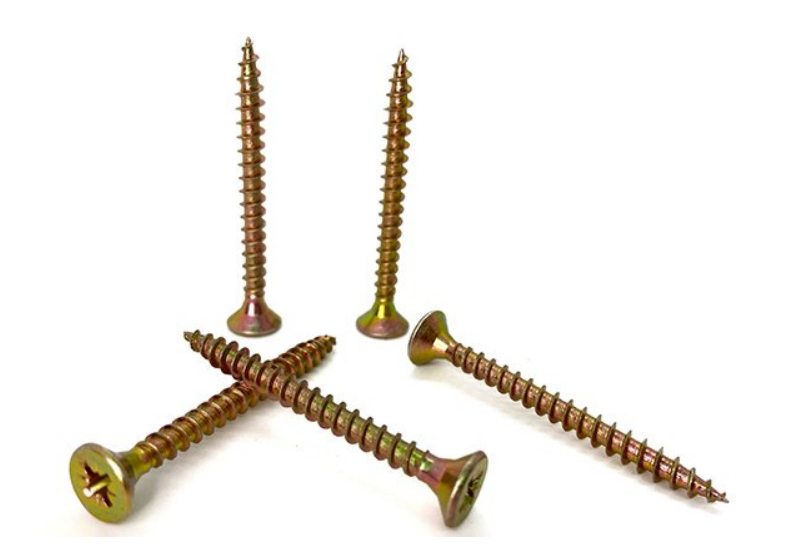
- Countersunk (CSK): The standard choice for furniture assembly — sits flush with the board surface
- Bugle head: A low-profile countersunk head with a curved underside — widely used in flooring to avoid surface damage
- Pan head: Used when flush fitting is not required — common in carcass construction where the head will be hidden
- Wafer head: Extra-wide, low-profile head provides a large bearing surface — preferred for thin sheet-on-sheet applications
When to Use Chipboard Screws
- Flat-pack furniture assembly and custom joinery cabinets
- Particleboard and MDF kitchen carcasses and wardrobe units
- Floating and tongue-and-groove engineered timber flooring
- Plywood subfloor installation over timber joists
- OSB sheathing in wall and roof diaphragm construction
- General sheet material fixing where a flush finish is required
💡 Pro Tip
When driving chipboard screws into MDF — which is denser and more prone to splitting than particleboard — always pre-drill a pilot hole within 50 mm of any edge. MDF has almost no tensile strength across its face and will crack without the relief provided by a pilot hole.
04. Side-by-Side Comparison
Use this reference table when sourcing your carpentry fasteners on-site or at the hardware store. The right screw for each application depends on substrate, load requirements, and environmental exposure.
| Feature | Timber Screws | Batten Screws | Chipboard Screws |
|---|---|---|---|
| Primary use | Timber-to-timber structural connections | Timber batten to masonry / steel substrate | Sheet materials: particleboard, MDF, plywood |
| Thread type | Single, coarse, deep thread | Coarse with smooth shank section | Twin-thread or double-lead |
| Diameter range | 4.0 – 10.0 mm | 6.3 – 8.0 mm | 3.0 – 6.0 mm |
| Typical length | 40 – 300 mm | 50 – 150 mm | 16 – 100 mm |
| Point type | Self-drilling / Type 17 | Self-drilling or self-tapping | Sharp point / partial drill |
| Drive type | Torx / Pozi / Hex | Hex / Torx | Pozi / Torx / Phillips |
| Pre-drill required? | No (most softwoods) | Sometimes (dense substrate) | Near edges in MDF |
| Outdoor rated? | Yes (Class 3/4) | Yes (galvanised) | Limited |
| Structural use? | Yes | Yes | Non-structural |
| Best for | Framing, decking, fencing | Roofing, cladding, steel frame | Furniture, cabinets, flooring |
05. How to Choose the Right Screw: A Practical Decision Guide
Answer these four questions before you reach for a box of screws. Getting this right upfront saves rework, prevents failures, and keeps your project code-compliant.
What are you fixing?
Solid or engineered timber → timber screws. Sheet material (MDF, particleboard, ply) → chipboard screws. Timber batten to masonry or steel → batten screws.
Will it bear structural loads?
Load-bearing connections need rated timber or batten screws. Non-structural interior joinery can use chipboard screws. Check AS 1720.1 for structural applications.
What is the environment?
Indoors, dry: standard zinc-plate is fine. Outdoors: Class 3 minimum. Near coast or high humidity: Class 4 or 316 stainless. Never use bare steel in treated timber (CCA/ACQ).
What length and gauge?
Length = at least 2× the thickness of the top member. Gauge: match to timber density. Hardwood needs a larger pilot; softwood and sheet materials are more forgiving.
06. Sizes, Grades & Corrosion Coatings
Selecting the correct size and corrosion resistance class is just as important as choosing the right screw type. Using an under-rated coating in an outdoor or treated timber application can cause the fastener to corrode within a few years — and in structural connections, that means failure.
Understanding Corrosion Resistance Classes
- Class 1 / Uncoated: Interior, dry environments only. Not suitable for any outdoor or humid application.
- Class 2 / Zinc electroplated: Interior or sheltered applications. Minimal outdoor resistance.
- Class 3 / Hot-dip galvanised or coated: Standard for outdoor timber screws in residential construction. Suitable for most external applications not in direct contact with CCA-treated timber.
- Class 4 / Heavy-duty coating: Required for screws in contact with ACQ, CCA, or other copper-based treated timber preservatives. Also used in aggressive coastal environments.
- Grade 304 Stainless Steel: Excellent corrosion resistance for most outdoor applications. Not recommended for direct coastal salt exposure.
- Grade 316 Stainless Steel: Marine-grade. The correct choice for coastal construction within 300 m of the ocean, swimming pools, and all marine structures.
Timber Screw Length Guide
| Application | Board / Member Thickness | Recommended Screw Length | Diameter |
|---|---|---|---|
| Decking (90×19 mm) | 19 mm | 50–65 mm | 4.0–4.5 mm |
| Decking (140×45 mm) | 45 mm | 90–100 mm | 4.5–5.0 mm |
| Fencing paling (75×19 mm) | 19 mm | 50 mm | 4.0 mm |
| Framing (90×45 mm) | 45 mm | 75–90 mm | 5.0 mm |
| 18 mm particleboard flooring | 18 mm | 50 mm | 4.0 mm |
| MDF cabinet carcass (16 mm) | 16 mm | 40 mm | 3.5 mm |
| Roof batten (50×35 mm) to steel | 35 mm batten + 25 mm steel | 75 mm | 6.3 mm |
📏 Golden Rule
As a general sizing rule, the screw should penetrate the receiving member by at least two-thirds of the total screw length. For example, a 75 mm screw through a 25 mm board leaves 50 mm of thread in the receiving member — ideal penetration.
07. Pro Installation Tips for Carpentry Fasteners
Even the best carpentry fasteners will underperform if they’re incorrectly installed. These techniques, used by experienced carpenters and structural builders, will help you get the most from every screw.
For Timber Screws
- Use a Torx (star) bit rather than Phillips — it transfers more torque, reduces cam-out, and extends bit life significantly
- Drive at 90° to the timber face unless specifying an angle for toe-nailing connections — angled fasteners have lower withdrawal ratings
- Keep screws at least 10× the screw diameter from the end grain and 5× from the edge grain to prevent splitting
- In hardwood (spotted gum, jarrah, blackbutt), always pre-drill with a bit 0.5 mm smaller than the shank diameter
- Never overtighten — drive until the head sits flush, not countersunk into the surface, unless a countersunk head is being used
For Batten Screws
- Check that the substrate anchor specification matches the batten screw system — not all batten screws are designed for direct masonry penetration
- Space batten screws at a maximum of 1,200 mm centres unless wind uplift calculations specify closer spacing
- Use a screw gun (not a drill-driver) for high-volume roofing batten work — depth-stop nose cones prevent over-driving
- Verify the pull-out rating of the batten screw matches your local wind region (W, N, C, TC in AS/NZS 1170.2)
For Chipboard Screws
- Pre-drill pilot holes within 50 mm of any edge in MDF or particleboard — this is non-negotiable
- Use wax or dry soap on the thread when driving into very dense particleboard — it reduces friction and prevents bursting
- Drive slowly through sheet material — high-speed drilling generates heat which degrades the resin binders in MDF and chipboard
- Never rely on chipboard screws in end-grain particleboard — end grain has almost zero holding power; use dowels, confirmat screws, or pocket holes instead
- For flooring applications, apply a bead of PVA or flooring adhesive in addition to screws — the combined mechanical and adhesive fix dramatically outperforms screws alone
08. Frequently Asked Questions
What is the difference between timber screws and chipboard screws?
Timber screws have a coarse, deep single-lead thread engineered to grip the grain structure of solid and engineered timber without splitting it — they are designed for structural load transfer. Chipboard screws use a fine twin-thread pattern that pulls composite particles together efficiently, providing a strong hold in lower-density materials like MDF and particleboard where solid grain structure doesn’t exist. Using a timber screw in thin MDF risks splitting; using a chipboard screw in a structural framing connection is under-rated for the load.
Can I use batten screws for general timber framing work?
Batten screws are specifically engineered for attaching timber battens to masonry, steel purlins, and concrete substrates. While their heavy-gauge bodies and coarse threads grip timber effectively, they are considerably heavier and more expensive than necessary for timber-to-timber framing. For general framing, structural timber screws in 4.5–5.0 mm diameter are the correct fastener — they carry appropriate load ratings and are designed for the application.
Do I need to pre-drill holes for timber screws?
Most modern timber screws feature self-drilling Type 17 or modified cutting points that eliminate the need for pre-drilling in standard softwoods (pine, cypress, radiata). However, for dense hardwoods such as spotted gum, jarrah, merbau, or blackbutt, a pilot hole 0.5 mm smaller than the shank diameter is strongly recommended. Always pre-drill when working within 50 mm of end grain or board edges to prevent splitting.
Are chipboard screws suitable for outdoor or wet areas?
Standard chipboard screws are typically zinc electroplated (Class 2) and are not rated for outdoor, wet, or high-humidity environments. In wet areas such as bathrooms or laundries, moisture will cause the zinc plating to break down and the steel shank to corrode — weakening the joint over time. For any outdoor application, choose Class 3 or Class 4 coated timber screws or 316 stainless steel fasteners. Chipboard screws used in cabinetry in high-humidity areas should be sealed against moisture ingress.
What size timber screws should I use for decking?
For standard 90×19 mm decking boards, 50–65 mm Class 4 coated or stainless steel timber screws in 4.0–4.5 mm diameter are the typical specification. For thicker 140×45 mm or 90×45 mm boards, use 90–100 mm screws at 4.5–5.0 mm. Always check your decking manufacturer’s fixing guide — some composite decking products require hidden clip systems rather than face screws, and some hardwood species require specific pre-drilling instructions to prevent splitting.
Can I use regular wood screws instead of chipboard screws in MDF?
Traditional coarse-thread general purpose screws can be used in MDF, but chipboard screws with their twin-thread profile will outperform them significantly. The twin thread draws the joint tight faster, generates less heat during driving, and provides greater pull-out resistance in the resin-bonded particle matrix of MDF. The countersunk head angle on chipboard screws is also typically shallower (approximately 25°) than general-purpose screws, which suits the denser surface layer of MDF and reduces surface blow-out.
09. Summary: The Right Carpentry Fastener for Every Job
Choosing between timber screws, batten screws, and chipboard screws is not complicated once you understand what each fastener is engineered to do. The core principle is simple: match the fastener to the material and the mechanical demands of the connection.
- Use timber screws for all structural timber-to-timber connections — framing, decking, fencing, joinery
- Use batten screws when you need to fix timber through to a harder substrate — concrete, brick, or steel purlins
- Use chipboard screws for all sheet material work — particleboard, MDF, plywood, OSB, and composite flooring
- Always consider the corrosion environment and select the appropriate coating or material grade
- Follow the length and spacing rules to achieve maximum holding power and prevent splitting
Investing in the correct carpentry fasteners at the outset is one of the simplest ways to ensure your build lasts for decades. The screws are almost always the cheapest component on a job — but they’re the ones holding everything together.